
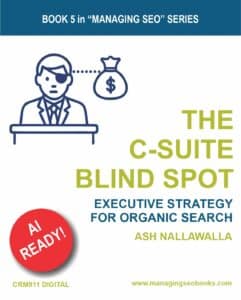
 Fifth Volume of the Managing SEO Series
ISBN: 978-0-6455232-8-7 | Planned Release February 2026
Most executives underestimate the power of organic search in this AI era — and it costs them money every quarter.
The C-Suite Blind Spot reveals why search visibility belongs in the boardroom and how to govern SEO as a strategic business capability, not a technical afterthought.
This volume distils decades of enterprise-level SEO leadership into a language executives understand: performance, risk, and return.
Background
The Managing SEO series began as a single comprehensive manuscript. Early reviewers — many of them former NASDAQ CEOs — had blunt feedback: “It’s too technical.”
That prompted a restructure into five focused books:
- Managing SEO – for busy SEO managers who want a condensed version of the next four books.
- Accidental SEO Manager – for marketing and operations leaders.
- AI Visibility Playbook – for those managing digital risk and compliance.
- Is Our SEO Working? – for measuring visibility and ROI.
- The C-Suite Blind Spot – for executives who fund and govern it all.
A few CEOs joked they might buy an SEO book only to shelve it — proof that this gap in understanding is real. This volume exists to close that gap.
Approach
From Neglect to Strategic Advantage
Too many organisations “do” SEO without truly governing it. Hiring someone with “SEO” in their title or engaging an agency is not the same as embedding SEO into strategic operations.
Unlike finance or HR, SEO has no formal academic pipeline; it remains a self-taught profession. Yet for many e-commerce and lead-generation companies, organic search drives 30 – 60 % of revenue.
This book challenges leaders to treat SEO as strategic infrastructure — an investment in brand visibility, margin, and long-term resilience.
Contents
Chapter 1 — The Blind Spot — Why Search Visibility Belongs in the Boardroom
This chapter establishes visibility as a board-level risk and fiduciary concern by exposing how value leaks through search and AI systems outside executive awareness.
Chapter 2 — The Hidden Cost of Under-Funding Visibility
This chapter reframes organic visibility as a margin protection issue, showing how chronic under-investment quietly erodes profitability and executive control.
Chapter 3 — SEO as Strategic Infrastructure
This chapter positions SEO as long-lived enterprise infrastructure rather than a marketing tactic, requiring the same leadership discipline applied to platforms, data, and security.
Chapter 4 — Governance and Accountability across Functions
This chapter explains how distributed ownership without executive governance guarantees visibility failure, even when teams perform competently.
Chapter 5 — AI and Automation — New Governance Imperatives
This chapter shows why AI-mediated discovery collapses traditional visibility assumptions and demands unified governance over automation, content, and machine interpretation.
Chapter 6 — Technology and Budget Governance
This chapter connects technology choices, funding discipline, and change control to visibility resilience, demonstrating why budget governance determines long-term discoverability.
Chapter 7 — Measuring What Matters — Performance, Risk, and Opportunity
This chapter redefines executive measurement away from activity reporting toward risk detection, signal integrity, and future-proofed visibility assurance.
Chapter 8 — Executive Dashboards for Visibility Governance
This chapter translates governance maturity and operational risk into board-ready dashboards that enable delegation without loss of accountability.
Chapter 9 — Executive Checklist and Scorecard
This chapter provides leaders with a practical mechanism to review, score, and sustain visibility governance without relying on specialist interpretation.
Chapter 10 — Securing Funding and Sustaining Governance
This chapter shows how governance maturity unlocks durable funding by converting visibility from a discretionary cost into a managed enterprise asset.
Chapter 11 — How Visible Organizations Stay Ahead
This chapter synthesizes leadership behaviors, organizational design, and cultural signals that allow visibility capability to survive change, disruption, and executive turnover.
Chapter 12 — Epilogue: Closing the Blind Spot
This chapter reinforces that visibility governance is ultimately a leadership mindset—one that determines whether organizations remain trusted, discoverable, and accountable in an AI-mediated market.
Summary
The C-Suite Blind Spot shows executives how to:
- Integrate SEO governance into corporate oversight and board reporting.
- Link search performance directly to financial outcomes.
- Build cross-functional accountability between marketing, IT, and compliance.
- Future-proof digital strategy against AI-driven disruption.
For the first time, SEO is presented not as a marketing tactic but as a governance discipline — one that protects brand visibility, revenue, and reputation in a world where every search result shapes shareholder value.
Leave your email address to be notified when this book is available for purchase (early 2026).