
This book is not in the Managing SEO Series, but would appeal to SEO professionals.
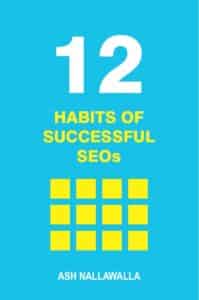 ISBN 978-1-7644704-2-1 | Planned Release Early 2026
Amazon Link: (tba)
This is a book about professional development through habit formation, focusing on the daily practices, thinking patterns, and behaviors that separate consistently successful SEO professionals from those who feel perpetually behind. The twelve habits in this book are drawn from two decades of field work—observing what separates consistently successful practitioners from those who struggle, and understanding the evolving demands of search itself. These aren’t personality traits you’re born with. They’re learnable, practicable skills you can develop starting Monday morning.
Several successful SEOs have added their own inputs to the book:
- Edward Bate
- Elie Berreby
- Michael Bonfils
- Jonathan Boshoff
- Jean-Christophe Chouinard
- Brodie Clark
- Jack Clark
- Gianluca Fiorelli
- Duane Forrester
- Saijo George
- Gagan Ghotra
- Mike Ginley
- Keith Goode
- Rachel Heseltine
- Adam Humphreys
- Dixon Jones
- Jess Joyce
- Noah Lerner
- Mika Lepisto
- Nitin Manchanda
- Casey Markee
- Michael Martinez
- Peter Mead
- James Norquay
- Dan Petrovic
- Gaston Riera
- Peter Rota
- Al Sefati
- Rasmus Sørensen
- Marty Weintraub
- Natalia Witczyk
The Twelve Habits
Habit 1: Continuous Learning
SEO changes daily. New ranking systems, shifting SERP layouts, and AI-driven retrieval require ongoing study. Successful SEOs schedule time to learn, test, follow patents and research, examine real-world data, and experiment on their own sites. Continuous learning creates adaptability and prevents stagnation.
Habit 2: Data-Driven Decision Making
Modern SEO requires analytical rigor. The best SEOs interpret analytics, Search Console data, log files, and user signals with precision. They form hypotheses, test their assumptions, and avoid guesswork. Data discipline prevents thrash and guides meaningful improvement.
Habit 3: Technical Precision
Crawlability, rendering, structured data, internal linking, mobile UX, and performance form the backbone of SEO. Technical precision means preventing regressions, validating assumptions, auditing consistently, and understanding how search engines and AI systems interpret content. Solid technical foundations eliminate avoidable losses and improve stability.
Habit 4: Content With Purpose
High-performing content is written to help users accomplish something, not to satisfy keyword checklists. Purpose-driven SEOs align content with actual user needs, clarify meaning, structure information for easy retrieval, and maintain content quality over time. This creates stronger engagement and better AI-driven visibility.
Habit 5: Relentless User Focus
Search exists to serve users, and search engines increasingly reward positive user outcomes. Top SEOs prioritize accessibility, readability, mobile usability, cognitive ease, and task completion. They reduce friction and design for clarity—knowing that satisfied users signal quality more reliably than any algorithmic factor.
Habit 6: Strategic Link Building
Links remain a key signal of authority, trust, and relevance. Strategic link builders earn links through value—research, tools, expert commentary, and digital PR—not through manipulation. Strong relationships, credible insights, and link-worthy assets create sustainable authority and strengthen entity signals.
Habit 7: Adaptability to Change
SEO is inherently volatile. Algorithms shift, SERPs evolve, AI systems reinterpret content, and user expectations change. Successful SEOs stay calm, diagnose issues methodically, avoid impulsive reactions, and adjust based on evidence. Adaptability prevents panic and supports stable decision-making.
Habit 8: Collaboration Without Friction
SEO work depends on developers, designers, content teams, product managers, analysts, and stakeholders. Effective collaborators communicate clearly, provide actionable documentation, respect others’ workflows, and anticipate friction. This accelerates implementation and ensures SEO insights translate into real improvements.
Habit 9: Process Discipline
Consistency beats sporadic brilliance. Process-driven SEOs build workflows, checklists, QA systems, and documentation that ensure repeatable excellence. They automate routine tasks, maintain standards, and reduce errors. Process discipline enables scaling and turns SEO into a reliable operational capability.
Habit 10: Strategic Patience
SEO improvements compound slowly. The best practitioners understand which actions take days, weeks, or months to produce results. They avoid thrash, interpret data in the right time horizons, and communicate realistic timelines. Patience prevents misdiagnosis and protects long-term growth.
Habit 11: Ethical Integrity
The temptation to take shortcuts is constant, but unethical SEO produces long-term damage: penalties, mistrust, brand risk, and AI retrieval suppression. Ethical SEOs practice transparency, avoid manipulation, and invest in sustainable credibility. Integrity is both a moral and strategic advantage.
Habit 12: Visionary Thinking
Today’s SEO must think beyond pages and keywords. Visionary SEOs understand systems: content ecosystems, knowledge graphs, user journeys, entity structures, AI retrieval patterns, and cross-channel visibility. They anticipate future needs and position their practice ahead of industry shifts. Leave your email address to be notified when this book is available for purchase (early 2026).